
The meaning of the phrase Shunyamsamya-samuchaya is that when the samuchya is the same then that samuchaya is zero. Samuchaya means a term or a group of terms containing constant numbers and variables. This chapter has five different parts.
Part A: Here the Samuchaya is the term which occurs as a common factor in all the terms of the equation.
Example 1: 
Here we observe that x occurs as a common factor in all the terms in the equation. Hence, x = 0 is the solution of the given linear equation.
Example 2: 
We can re-write this equation as 
Now (x+1) is the common term (Samuchaya) on both sides, hence x + 1 = 0 giving the solution x = -1.
Example 3: 
Step 1: Transpose 786 to the left side and 483 to the right side
Step 2: 
Step 3: 
Step 4: x-1 = 0 [Since (x -1) is the common factor or the samuchaya]
Step 5: x =1
Exercises: Solution









Part B: Here the Samuchaya is the product of the constant terms on both sides of the equation.
Example: 
Here we observe that the product of the constants on both sides is equal to 63
(ie 7 x 9 = 63 and 3 x 21 = 63. Hence, the variable term x should be equal to 0.
So the solution is x = 0.
Important note: The coefficient of x2on both sides should be equal.
Exercises: Solution






Part C: Here Samuchya means the sum of the denominators of two fractions having the same numerator.
Example 1:
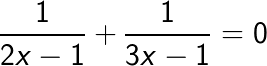
Step: 1 Observe that both the numerators are same(=1)
Step: 2 Add the Denominators 
Step:3 Equate the sum of denominators to zero in order to obtain the final solution
Hence
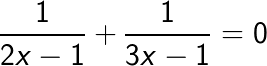


 is the required solution
Example 2:
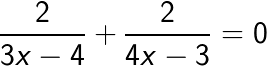




Exercise Solution
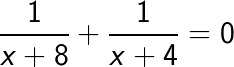

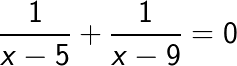

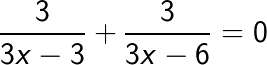

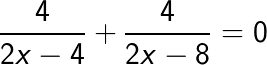

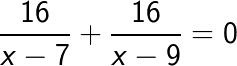

Part D : Here Samuchya means the sum of the numerators and the sum on the denominators of both fractions
Example 1:
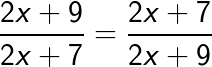
Step 1: Add the numerators of both fractions 
Step 2: Add the denominators if both fractions 
We observe that


Hence the sum 
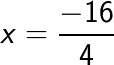
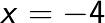 is solution
Example 2:
If the sum of numerators and sum of denominators is not equal. but if one is a multiple of the other than still we can put the sum equal to zero ( after removing the multiple)
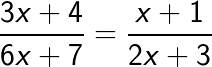

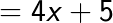


we observe that

So we can remove the multiple 2
giving us 


is the required solution
Exercise Solution
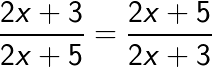

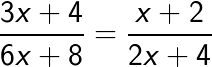

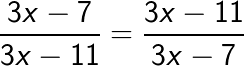

Part E : Here If All the numerators are equal the Samuchaya here means the sum of denominators on both sides (LHS and RHS) of the equation
Example 1:

Step 1 : Observe that all the numerators are equal (=1)
Step 2 : Add Denominators on LHS 
Step 3: Add Denominator on RHS 
Step 4:  (Make the sum of denominators = 0)
Step 5:  is the subtraction
Example2:



Hence 
or 
Example 3:

Here we observe that sum of denominators on both sides of equation are different
Now we need to transpose the negative terms on both sides

Now 

 is the solution
Exercise Solution






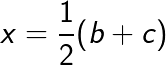
Note here b,c,d are some constants


Corollary of
Part E: if the numerators are not equal, then we can equalize them by taking their LCM(lowest common multiply) and than multiply the fractions accordingly
Example

Step 1: Take LCM of Numerators LCM (2,3,1,6)=6
Step 2: Make all numerators = 6



So now we can rewrite the equation as

Now take the sum of denominators on both sides of equation


Hence
 is the solution
Exercise Solution





Course:

Links
[1] https://hootsgo.com/?q=node/6542
[2] https://hootsgo.com/?q=node/6482
[3] https://hootsgo.com/?q=course/vedic-math